The Association of Natural Rubber Actors of Ghana (ANRAG) has dismissed claims questioning its legitimacy, pricing influence and the structure of Ghana’s rubber market.
At the same time, the Association has raised concerns over foreign-exchange compliance, export valuation practices and the long-term sustainability of financing in the rubber industry amid the continued export of raw natural rubber.
A statement issued and signed by Perry Acheampong, Secretary of ANRAG, marked outrecent allegations by the Rubber Farmers Association of Ghana (RUFAG) and the Western Rubber Farmers Association (WRUFA) as misleading and unsupported by evidence, insisting that both pricing data and export figures contradict the narrative being presented to policymakers and the public.
Legitimacy and mandate
The statement explained that ANRAG is a legally constituted, non-profit industry association established under the Companies Act, 2019 (Act 992).
The Association stressed that it was formally inaugurated by the Tree Crops Development Authority (TCDA) on August 15, 2024, and that its National Executive Council was sworn into office on the same date.
“Any claims that ANRAG is an illegitimate or self-appointed body are factually incorrect,” the statement said, clarifying that ANRAG does not exercise regulatory authority but serves as an umbrella body bringing together farmers, processors, traders, aggregators, nursery operators, and input suppliers to promote sustainable development, value addition, and orderly market conduct.
Pricing data undermines farmer-welfare argument
According to the statement, a central plank of opposition to restrictions on raw rubber exports has been the assertion that farmers would be worse off if exports were curtailed. ANRAG said the 2025 farmer purchasing pricing data directly contradict this claim.
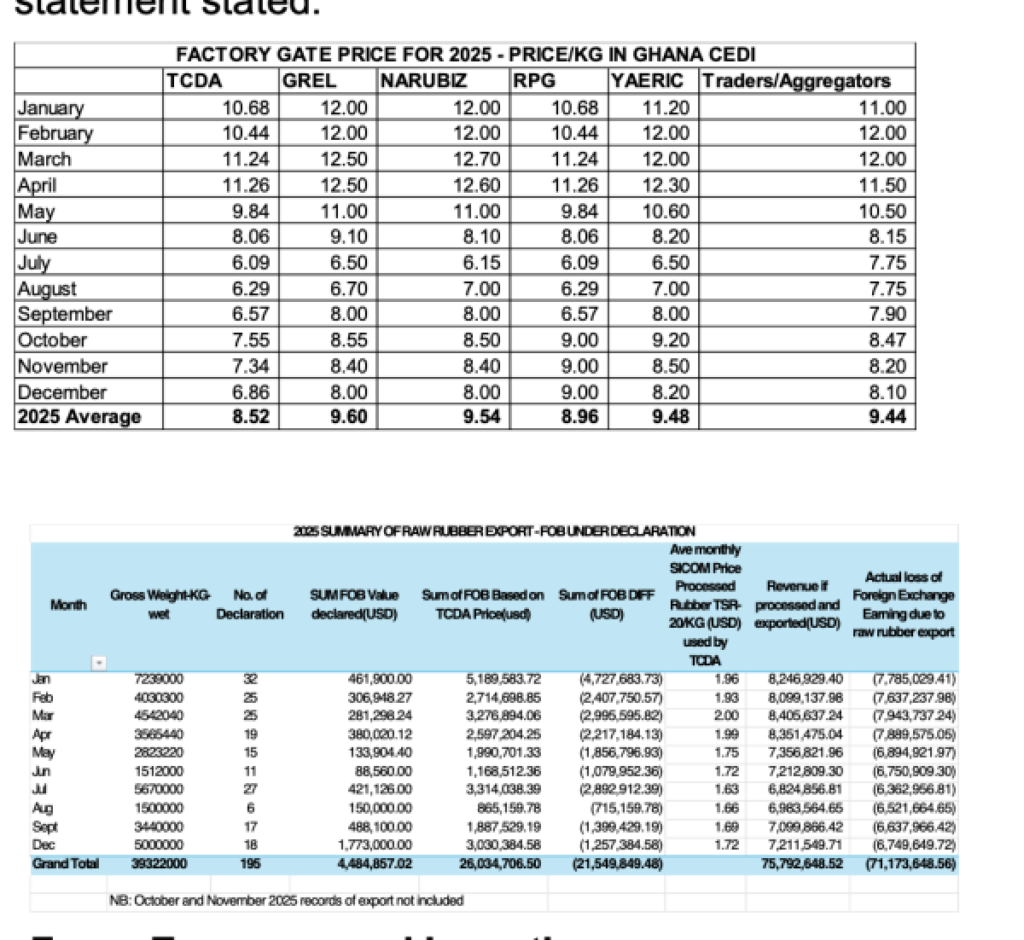
The statement said the statutory minimum producer price set by the TCDA averaged GH¢8.52 per kilogram in 2025, while actual prices paid by processors, traders, and aggregators consistently exceeded this floor throughout the year.
ANRAG noted that processors paid prices comparable to, and in several cases higher than, those offered by traders and aggregators, demonstrating that the minimum price regime functions as a protective floor rather than a price ceiling.
“This evidence does not support the claim that farmers depend on exports to secure fair prices,” the statement stated.
No monopoly in the rubber industry
The ANRAG statement also rejected allegations that GREL monopolises the rubber industry, noting that Ghana currently has seven licensed rubber processing factories, alongside numerous licensed traders and aggregators operating in the market.
“A market with multiple processors and competing buyers cannot be labelled a monopoly,” the statement stressed.
Export volumes, valuation, value addition losses and regulatory process
Beyond pricing, the statement said the more contentious issues concern export valuation, lost value addition, and the regulatory process.
Export data for 10 months of 2025 (January–September and December) indicate that approximately 39,000 metric tonnes of raw rubber were exported under 195 separate export declarations.
The statement pointed out that Based on declared customs records, the total Free on Board (FOB) value of these exports stood at approximately USD 4.48 million. However, when benchmarked against the TCDA minimum purchase applicable referenceprices, ANRAG’s preliminary analysis suggests an indicative export value of about USD 26.03 million, implying a potential FOB valuation gap of USD 21.55 million.
Beyond valuation gaps, the statement highlighted the loss of domestic value addition arising from the export of raw rubber rather than local processing. Using prevailing international prices for processed rubber products based on TCDA’s monthly pricing determination, the Association estimated that, if the same volumes exported over the 10-month period had been processed domestically, Ghana could have generated approximately USD 75.79 million in export revenue based on the SICOM Price for processed rubber(Technically Specified Rubber –TSR) used by TCDA in the minimum purchase price.
Compared with the declared USD 4.48 million earned from raw rubber exports, the statement said this translates into estimated foregone value-addition and foreign-exchange earnings of about USD 71.17 million. ANRAG said this represents not only lost export revenue but also missed opportunities for factory utilisation, employment, tax receipts, and downstream industrial growth.
In addition to valuation and value-addition concerns, the statement referenced Regulation 50 of the Tree Crops Development Authority Regulations, 2023 (L.I. 2471), which requires that where a produce of a tree crop is intended for export, the Tree Crops Development Authority (TCDA) shall, in consultation with the relevant value-chain committee, determine the proportion of the produce that must be reserved for sale at the prevailing market price to local processors.
Conforming to ANRAG, the statement said it is not aware that the mandatory consultation with the Rubber Value Chain Committee of the TCDA Board took place prior to the issuance of permits for raw rubber exports, raising concerns about adherence to the prescribed process under the regulation.
The statement stressed that addressing export valuation discipline, enforcing local-market reservation requirements, and aligning exports with domestic processing capacity are critical to safeguarding value addition, foreign-exchange earnings, and the long-term sustainability of Ghana’s rubber industry.
Forex Exposure and Incentives
The ANRAG statement identified the valuation gaps within Ghana’s foreign-exchange framework, under which exporters are required to fully declare export values and repatriate foreign-exchange proceeds through authorised banking channels.
The Association argued that persistent under-declaration of FOB values, if established, would reduce the amount of foreign currency required to be repatriated, creating short-term incentives that favour continued raw material exports over domestic processing.
While stopping short of alleging non-compliance, the statement said exporters’ resistance to restrictions “raises legitimate questions about who benefits most from the current export regime.”
Credit financing fallout and banking exposure
The statement linked the continued export of raw rubber to mounting stress within the sector’s long-standing credit-financing framework, warning that export diversion has undermined repayment capacity and placed rubber outgrower development loans at risk.
Based on the statement, structured tripartite financing arrangements involving farmer groups (ROAA and AERRO), technical operators, and financial institutions, principally the Agricultural Development Bank (ADB) and the National Investment Bank (NIB), were established over two decades to support plantation development, farmer outgrower schemes, and domestic processing capacity.
These facilities the statement added were implemented by technical operators, including Ghana Rubber Estates Ltd (GREL) and Rubber Processing Ghana Limited (RPGL), in collaboration with organised farmer groups, that is, ROAA and AERRO.
ANRAG said the financing structures were premised on predictable domestic raw material supply and stable factory off-take, assumptions that have been undermined by the sustained export of raw rubber since 2016.
Tripartite credit facilities supporting Ghana’srubber sector
The statement noted that between 1995 to 2016these facilities supported over 9,200 farmers, financed more than 32,000 hectares, and involved total credit exposure of approximately €61.8 million.
According to the Association, the diversion of raw rubber away from domestic processors has weakened cash flows across the value chain, stalled plantation reinvestment, and increased repayment risk on these facilities, with implications for farmers, processors, and the banking sector.
Farmers not the source of resistance
The statement rejected claims that farmers oppose restrictions on raw rubber exports, stating that farmers enjoy guaranteed market access and receive prices above the statutory minimums, regardless of export activity.
“The narrative that farmers are resisting export restrictions does not align with pricing or market evidence,” the statement said.
Support for TCDA and call for unity
The statement emphasised that it has never opposed lawful trading or export activity and has consistently worked with TCDA since its formation in 2024, mobilising and registering value-chain actors, sensitising traders and aggregators to regulatory obligations, supporting stakeholder engagement, and facilitating the organisation of trader associations.
The statement reiterated its full respect for TCDA’s statutory authority, noting that regulation, minimum price-setting, monitoring, and enforcement remain the exclusive mandate of the Authority under Act 1010 and L.I. 2471.
The statement resolved by calling for unity across the rubber value chain, stressing that sustainable industry growth depends on coordinated action on pricing discipline, export governance, financing, and value addition.
Call for data-driven oversight
The ANRAG statement said its analysis is intended to inform policy rather than prejudge regulatory findings, urging data-driven oversight of export valuation, foreign-exchange outcomes, and sector financing.
As Ghana seeks to strengthen its balance-of-payments position and deepen agro-industrial value chains, the debate over raw rubber exports is increasingly seen as a test of how effectively export valuation discipline, forex compliance, and industrial policy align in practice.