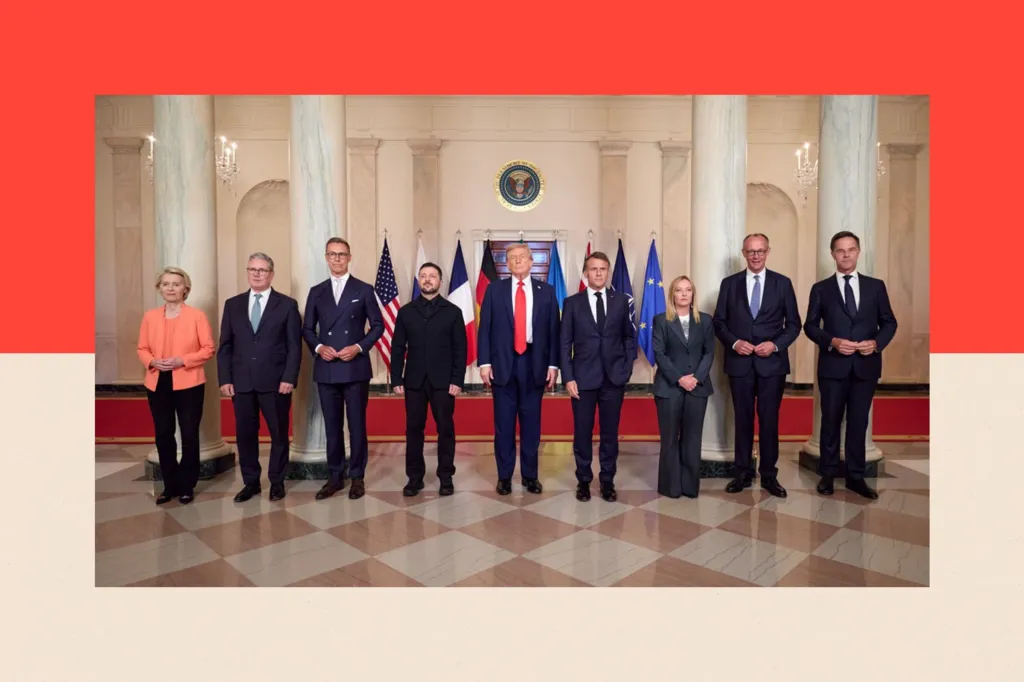
For 80 years, what bound the United States to Europe was a shared commitment to defence and a common set of values: a commitment to defend democracy, human rights and the rule of law.
That era was inaugurated in March 1947 in an 18-minute speech by President Harry Truman, in which he pledged US support to defend Europe against further expansion by the Soviet Union.
America led the creation of Nato, the World Bank, the IMF and the United Nations. And it bound itself into what became known as the “rules-based international order“, in which nation states committed to a series of mutual obligations and shared burdens, designed to defend the democratic world against hostile authoritarian powers.
Now, the new US National Security Strategy (NSS), published in December, signals that, for the White House, that shared endeavour has ended; that much of what the world has taken for granted about America’s role is over.
The review refers to the “so-called ‘rules-based international order'”, putting the latter phrase in inverted commas: a kind of delegitimisation by punctuation mark.
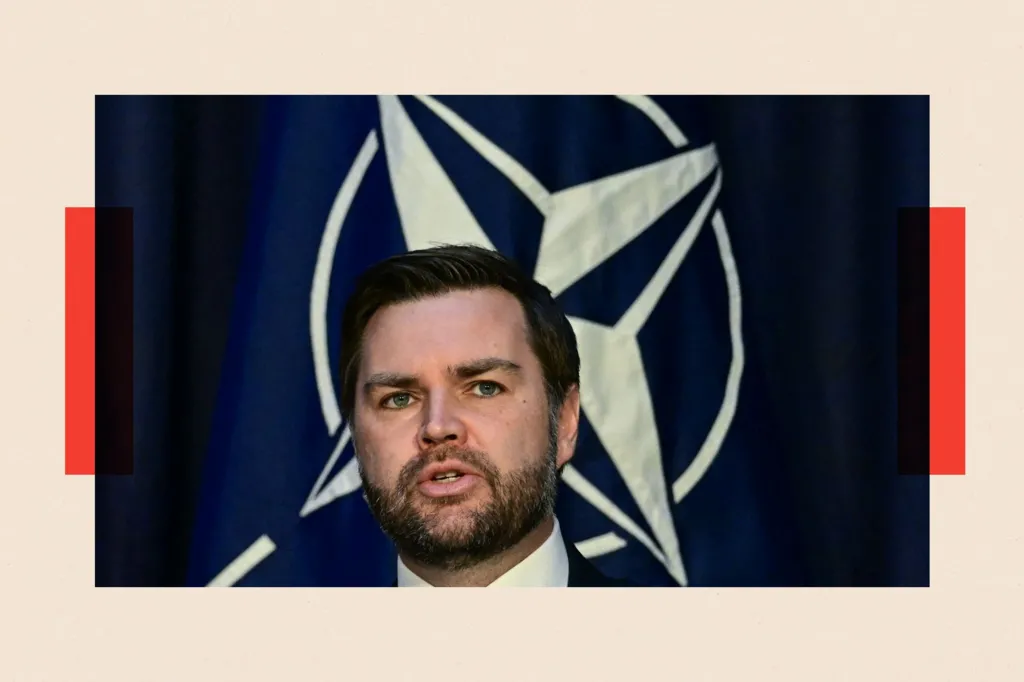
Vice-President JD Vance warned America’s European allies that this was coming in a speech at the Munich Security Conference in February 2025.
He told them bluntly that the real threat to Europe did not come from Russia but from within – from those censoring free speech, suppressing political opposition and therefore undermining European democracy. And he was damning about the “leftist liberal network”.
The French newspaper Le Monde said the speech was a declaration of “ideological war” against Europe.
Last month’s NSS codifies Vance’s remarks, and, in black and white, elevates them to the status of doctrine.
“Certainly America is no longer the country that promoted the global values that have been in place since the end of the Second World War,” says Karin von Hippel, who previously held senior positions in the US State Department and is a former Director of the Royal United Services Institute (Rusi), a Whitehall think tank.
“It is shifting to a very different place.”
So, if the world is indeed moving away from that order, what is it moving towards? And what does it mean for the rest of the world and in particular for Europe?
‘We have a different world today’
“International institutions, notably the United Nations, have been marked by dramatically anti-American sentiment, and have not served our or any other particular purpose,” says Victoria Coates, a vice-president at The Heritage Foundation, a prominent right-wing think tank in Washington.
In the eyes of Coates – who was previously the Deputy National Security Adviser to US President Donald Trump – change to the international order is inevitable in a changing world.
“The other issue we face here is that when that so-called rules-based international order was established after the Second World War, 80 short years ago, China wasn’t a major concern.
“We just have a different world today.”

This rules-based international order, built in the years after World War Two, was created by a generation that had come of age during an era of Great Power geopolitics, and had seen that system descend, twice, into catastrophic global conflict.
That international order, flawed and incomplete though it undoubtedly was, was the legacy of that experience.
But the NSS directly argues that American strategy went astray in the years since – and it blames what it calls “American foreign policy elites”.
“They lashed American policy to a network of international institutions, some of which are driven by outright anti-Americanism and many by a transnationalism that explicitly seeks to dissolve individual state sovereignty,” it says.
It suggests that in future, the US will seek to roll back the influence of supranational bodies.