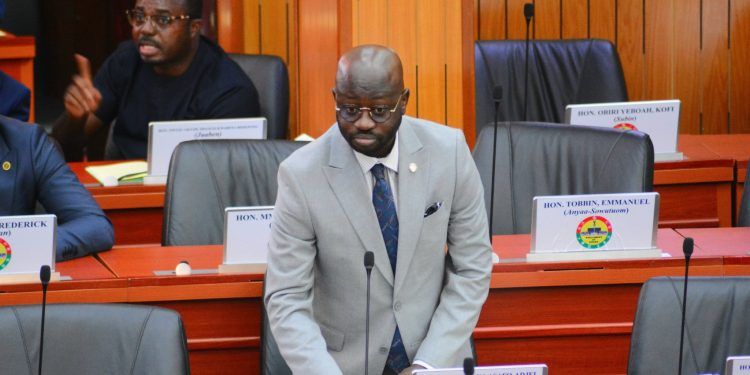
The Member of Parliament for Bosome Freho, Nana Asafo-Adjei Ayeh, has raised concerns over the government’s newly announced “free e-visa” policy for African travellers, arguing that it does not constitute a genuinely visa-free regime as widely portrayed.
The government recently announced that Ghana will roll out a free electronic visa system for African travellers effective May 25, 2026, as part of activities marking Africa Day
The Minister for Foreign Affairs, Samuel Okudzeto Ablakwa, went on to add that the move does not amount to visa-free entry, saying that while the fee is waived off, all applicants will still be subject to a formal visa application and screening process.
However, Nana Asafo-Adjei Ayeh contends that the policy, in its current form, still imposes administrative requirements that undermine the essence of visa-free travel.
According to him, the so-called “Free Visa for Africans” policy is embedded within a broader e-visa framework, which requires travellers to undergo a digital application and approval process before entering the country.
“Crucially, as has already been indicated by the Minister for Foreign Affairs, the ‘Free Visa for Africans’ policy is a component of the broader e-visa initiative,” he stated in a Facebook post on Friday, April 3, 2026.
He stressed that this distinction is critical, as it changes the actual experience of travellers despite the removal of visa fees.
“It is not, in strict terms, a visa-free regime, but rather a digitised, pre-authorisation system, albeit one that does not impose a financial charge,” he stated.
The MP further argued that true visa-free travel should eliminate the need for any prior application or approval, thereby allowing seamless movement across borders.
“Visa-free travel, in its true sense, eliminates the need for prior application or pre-authorisation, thereby allowing travellers to move with minimal administrative impediment,” he noted.
He questioned whether the current approach genuinely facilitates easier travel across the continent.
“It is therefore legitimate to pose a simple but critical question. From the perspective of an African traveller, which regime is more facilitative? One that permits travel without prior administrative processes, or one that conditions travel on prior digital application and approval?” he queried.
While acknowledging the role of technology in modern border management, Nana Asafo-Adjei Ayeh cautioned that digital systems should not become barriers to mobility.
“Digital systems can enhance efficiency, security, and coordination. However, such systems must operate in a manner that complements, rather than constrains, the overarching objective of free movement,” he added.
He called on the government to provide greater clarity on the policy’s practical implications for travellers, stressing the need for transparency in how such initiatives are communicated to the public.